


A pallet truck may look like a simple piece of warehouse equipment, but choosing the right one involves much more than checking its maximum load capacity. Two pallet trucks with similar ratings can perform very differently depending on how far loads travel, how often the equipment is used, what type of floor it runs on, and how much space operators have to maneuver.
Equipment selection also matters from an ergonomics standpoint. In 2024, the U.S. Bureau of Labor Statistics recorded 77,000 workplace injury and illness cases in the warehousing and storage industry, with a total recordable case rate of 4.8 cases per 100 full-time workers.
The goal, therefore, isn't simply to buy the pallet truck with the highest specifications. It's to choose the truck that best fits your actual workflow.
If you're still comparing the basic types of pallet trucks, start with our Pallet Trucks Guide: Types, Key Terms & Use Cases. If you already know the basics, use the seven factors below to narrow down the right model.
1. Start With Your Workload and Travel Distance
One of the first decisions is whether you need a manual or electric pallet truck.
Manual pallet trucks are often the most practical option for occasional, short-distance moves—such as transferring pallets from a receiving dock to a nearby staging area, repositioning inventory, or supporting a smaller warehouse. They have a lower initial cost, require no charging infrastructure, and are simple to keep available as backup equipment.
As workload and travel distance increase, however, electric drive becomes more valuable. OSHA ergonomics guidance specifically notes that motorized pallet jacks are preferred for frequent or long-distance travel, helping reduce the physical demands associated with repeatedly moving heavy loads manually.
This is a real concern for growing operations. In a 2026 discussion, one mid-sized FBA operator handling around 500 units per day described manual inventory movement as becoming physically demanding and began evaluating whether it was time to upgrade from manual to electric equipment. Other warehouse users recommended keeping manual pallet jacks for lighter or backup tasks while using powered equipment for heavier, more frequent moves.
A simple rule: the heavier, farther, and more frequently you move pallets, the stronger the case for electric assistance.
2. Match Load Capacity to Your Actual Pallet Weight
Load capacity is important, but don't choose it based only on your average pallet.
Instead, identify:
- Your typical pallet weight
- Your heaviest regularly handled pallet
- Any predictable peak-load requirements
The truck should comfortably accommodate the heaviest loads it will routinely handle. Avoid planning to operate continuously at the truck's maximum rated capacity.
At the same time, don't assume that more capacity is always better. A higher-capacity truck may cost more or be larger than your operation actually requires.
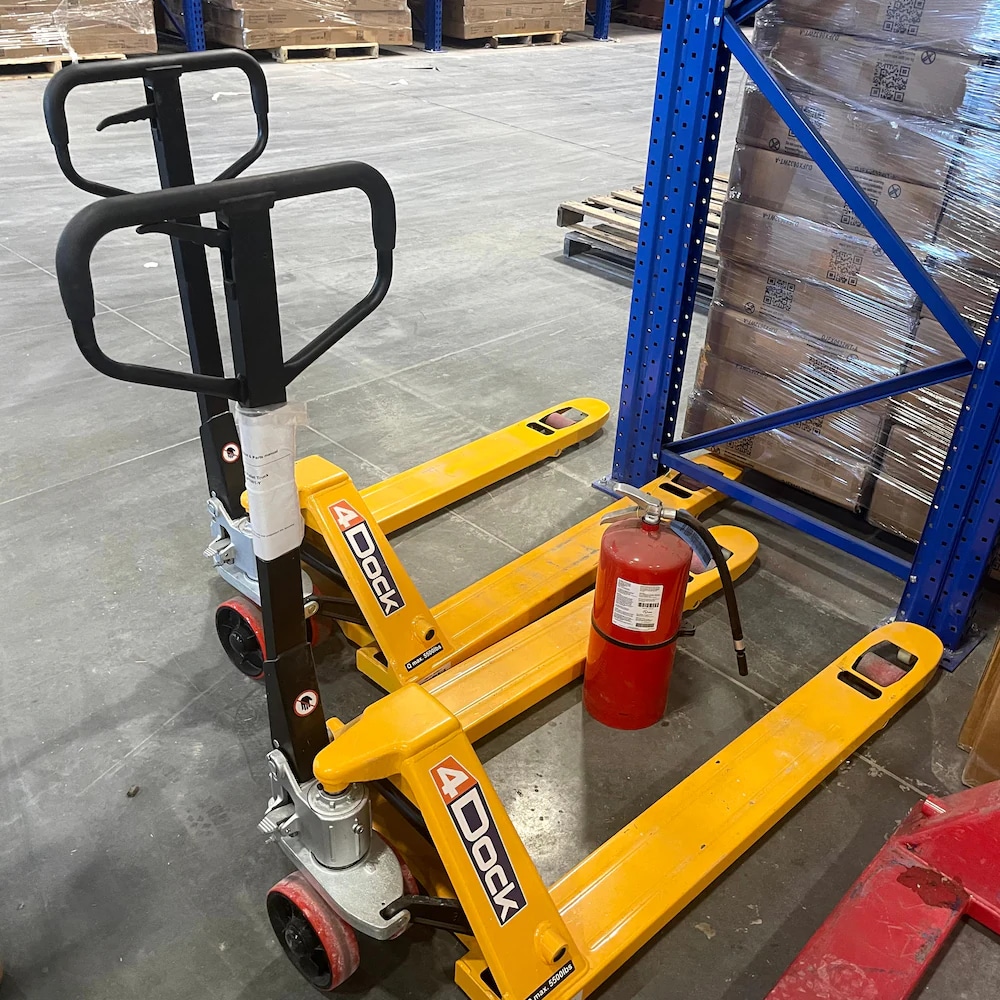
For example, 4Dock's standard manual pallet trucks are rated for 5,500 lbs, making them suitable for many general warehouse applications. The manual pallet truck with an integrated digital scale also handles up to 5,500 lbs, while the compact electric pallet truck is rated for 3,300 lbs and the manual high-lift model for 2,200 lbs.
Those differences illustrate an important point: capacity should match the job the truck is designed to perform, not simply the largest number available.
3. Check Fork Width and Length Against Your Pallets
Fork dimensions are easy to overlook when comparing pallet trucks online, but they directly affect pallet compatibility.
Before ordering, check your pallet's:
- Entry openings
- Overall width
- Entry direction
- Load footprint
- Required fork length
A pallet truck can have enough load capacity and still be the wrong fit for your pallets.
For example, 4Dock's standard manual pallet trucks are available with 48" × 21" and 48" × 27" fork configurations, while the compact electric model uses 48" × 27" forks.
Narrower forks can be useful with certain pallet formats and tighter applications, while wider forks provide a better fit for other common pallet footprints.
Buyer Tip: Measure your most commonly used pallets before ordering—not after the truck arrives.
If your facility uses several pallet sizes, check compatibility with all high-volume pallet types rather than measuring only one.
4. Choose the Right Wheels for Your Floor
Wheel material can have a noticeable impact on rolling resistance, noise, operator effort, and durability.
PU Wheels
Polyurethane, or PU, wheels are a strong choice for smooth indoor environments such as:
- Finished concrete floors
- Epoxy-coated floors
- Warehouses
- Retail backrooms
- Noise-sensitive work areas
4Dock's standard pallet truck with PU wheels is designed to provide smoother, quieter rolling for indoor warehouse applications.
Nylon Wheels
Nylon wheels are better suited to many demanding industrial applications where durability and low rolling resistance are priorities. Typical applications include loading areas, factories, cold-storage environments, and facilities where pallet trucks frequently handle heavier loads.
4Dock's nylon-wheel models are designed for heavier loads, longer travel distances, and more demanding floor conditions.
Floor condition matters just as much as wheel material. OSHA guidance emphasizes selecting appropriate wheels and maintaining both equipment and travel surfaces because these factors directly affect the force required to move wheeled material-handling equipment.
Don't choose PU versus nylon in isolation—choose the wheel based on where the truck will actually run every day.
5. Consider Aisle Width and Maneuverability
A pallet truck that feels easy to operate on an open loading dock can feel very different inside a crowded aisle, trailer, or container.
Before purchasing, look at:
- Aisle width
- Turning space
- Dock layout
- Trailer or container dimensions
- Congested staging areas
- Obstacles around workstations and storage zones
For tight spaces, turning radius can be as important as overall truck dimensions.
For example, 4Dock's compact electric pallet truck has a 57.1" turning radius and is designed for applications such as trucks, containers, and narrow aisles. Its Turtle Mode also allows more controlled low-speed maneuvering in confined spaces.
For a warehouse with limited room, maneuverability may matter more than maximum travel speed.
6. Decide Whether You Need a Specialized Pallet Truck
Not every operation is best served by a standard pallet jack.
If your workflow includes additional steps such as weighing or repeated work at pallet level, a specialized model can eliminate unnecessary handling.
Pallet Truck With Digital Scale
A pallet truck with an integrated scale can be useful for:
- Shipping preparation
- Receiving
- Freight weight checks
- Inventory verification
- Operations currently moving pallets to a separate floor scale
4Dock's manual scale pallet truck combines a 5,500-lb capacity with an integrated digital scale, a stated weighing error of ±0.1%, and lb/kg switching.
The benefit isn't simply an extra feature—it is the ability to move and weigh the pallet within the same workflow.
High-Lift Pallet Truck
A high-lift pallet truck is useful when workers need materials positioned at a more comfortable working height during packing, assembly, loading, or production tasks.
OSHA notes that height-adjustable pallet jacks and similar equipment can help improve working posture by reducing unnecessary bending and reaching.
The 4Dock manual high-lift model combines pallet transport and scissor-lift functionality with a 2,200-lb capacity.
Choose specialized equipment because it removes a recurring workflow problem—not simply because it has more features.
7. Compare Total Cost of Ownership, Not Just Purchase Price
Manual pallet trucks normally have an obvious advantage in upfront cost. They also have fewer electrical components, no charging requirements, and can be valuable as simple backup equipment.
Electric pallet trucks require a larger initial investment and introduce battery, charging, maintenance, and operator-training considerations. But in high-frequency operations, purchase price tells only part of the story.
Powered movement can reduce the effort required to repeatedly move heavy pallets and may improve productivity when loads travel farther or more frequently.
When comparing electric pallet trucks, consider:
- Battery runtime
- Charging time
- Battery replacement cost
- Battery swapping
- Parts availability
- Maintenance access
- Planned downtime
For example, 4Dock's compact electric pallet truck uses a 24V/20Ah lithium battery, charges in approximately 3.5 hours, and includes a quick-release battery design intended to reduce downtime.
Warehouse investment decisions are increasingly moving in this direction. Rising throughput expectations and a tight labor market are encouraging warehouse operators to evaluate equipment based on process efficiency and labor productivity rather than purchase price alone.
For high-use equipment, uptime and labor efficiency may ultimately matter more than a small difference in initial price.
Quick Pallet Truck Selection Guide
| Your Operation | Recommended Pallet Truck |
| Occasional, short-distance moves | Standard Manual Pallet Truck |
| Frequent or longer-distance moves | Electric Pallet Truck |
| Smooth indoor or noise-sensitive areas | PU Wheel Pallet Truck |
| More demanding industrial floors | Nylon Wheel Pallet Truck |
| Need to weigh pallets while handling them | Pallet Truck With Digital Scale |
| Need materials at a better working height | High-Lift Pallet Truck |
| Narrow aisles, trailers, or containers | Compact Electric Pallet Truck |
Remember that one facility doesn't necessarily need one pallet truck type for every job. A warehouse may use electric trucks for its highest-volume routes while keeping manual pallet jacks available for occasional moves, loading areas, and backup use.
Final Checklist Before You Buy
- What is the heaviest pallet we regularly handle?
- How far does a pallet typically travel?
- How many pallet moves occur per shift?
- What pallet dimensions do we use?
- What are our floor conditions?
- How much turning space is available?
- Do we need integrated weighing or high-lift capability?
- If choosing electric, what runtime and charging setup do we need?
Once these questions are answered, comparing pallet trucks becomes much easier—and much less dependent on guessing from specifications.
Find the Right Pallet Truck for Your Operation
There is no single “best” pallet truck for every warehouse. The right choice depends on your load weight, pallet dimensions, travel distance, floor conditions, available space, and daily handling frequency.
For short and occasional moves, a standard manual pallet truck may be all you need. High-frequency workflows may justify electric drive, while applications involving weighing or repeated work at pallet level may benefit from specialized equipment.
Compare manual, electric, high-lift, and weighing pallet trucks to find the right fit for your warehouse.