


How to Choose a Semi-Automatic Stretch Wrapper: 7 Things to Check Before You Buy
When pallet wrapping starts taking too much time, the first instinct may be to search for the “best semi-automatic stretch wrapper.” But that is usually the wrong place to start.
The better question is: Which stretch wrapper fits the way your operation actually works?
A small fulfillment center wrapping 20 similar pallets throughout the day has different requirements from a manufacturer handling tall, unstable loads or a warehouse processing most outbound pallets during a two-hour shipping rush.
That is why machine selection should begin with your operation—not a specification sheet.
Before you buy a semi-automatic stretch wrapper, evaluate seven things: pallet volume, load dimensions, material-handling workflow, film control, total operating cost, maintenance requirements, and expected growth.
Here is how to work through those decisions.
First, Do You Actually Need a Semi-Automatic Stretch Wrapper?
Semi-automatic equipment usually becomes worth investigating when manual wrapping has stopped being a minor shipping task and started becoming a repeatable operational bottleneck.
Watch for signs such as:
- Pallet volume increasing faster than shipping labor
- Employees spending significant time walking around loads with hand film
- Wrap quality varying noticeably between operators
- Inconsistent film usage
- Pallet wrapping backing up during peak shipping periods
- Repetitive wrapping becoming a worker-fatigue concern
The ergonomics issue is worth taking seriously. OSHA identifies repetitive motion, bending, awkward postures, pushing, and pulling as ergonomic risk factors in warehousing. In its warehousing guidance, OSHA specifically identifies wrist overexertion associated with stretch wrapping orders and lists mechanical stretch wrappers as one potential control.
But moving away from hand wrapping does not automatically mean jumping to a fully automatic line.
Think of the progression as:
Manual wrapping → Semi-automatic wrapping → Fully automatic wrapping
For operations that need greater consistency and less repetitive manual wrapping but do not require a fully integrated packaging line, semi-automatic equipment can occupy a useful middle ground.
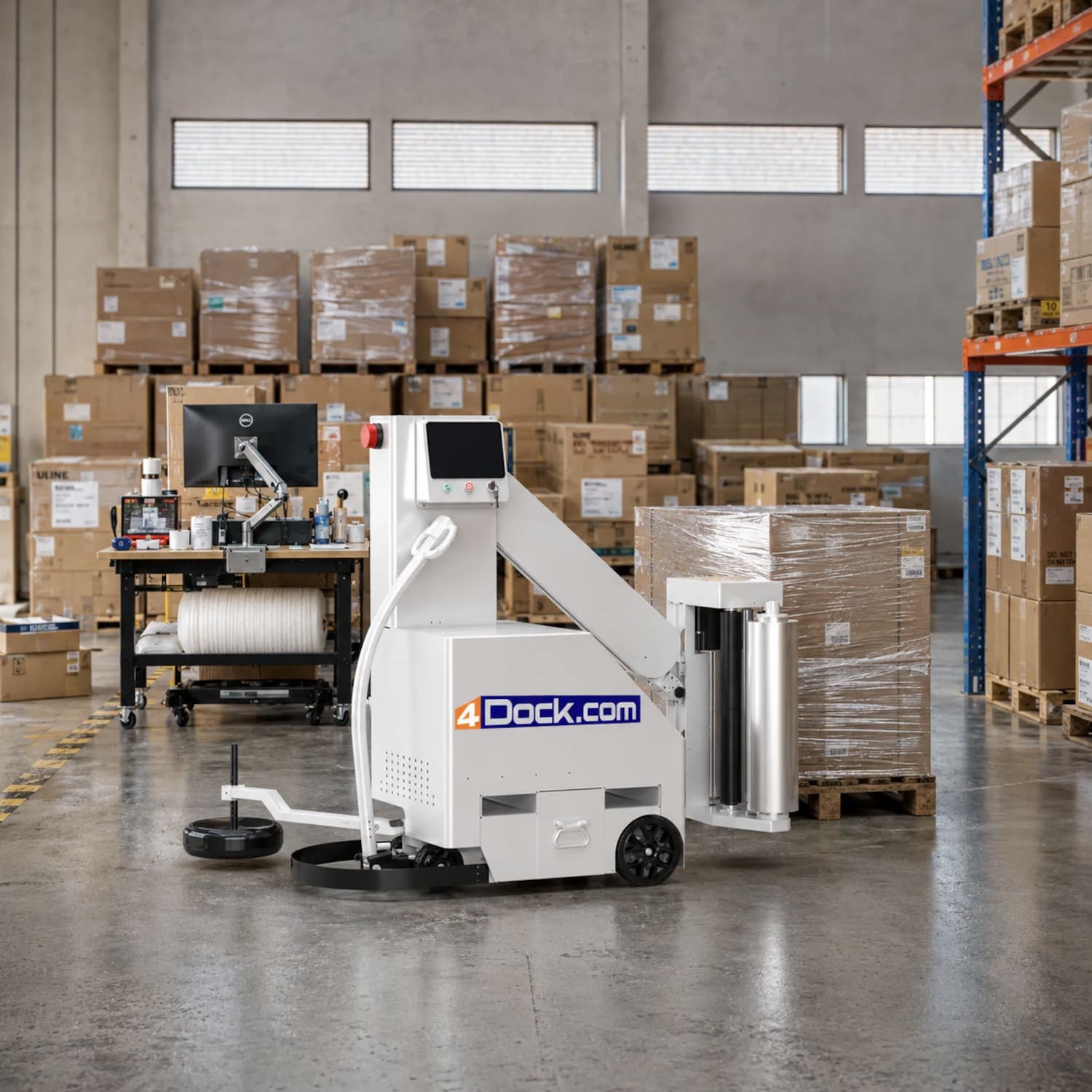
1. Start With Your Real Pallet Volume
“How many pallets do you wrap per day?” sounds like a simple question. It isn't enough on its own.
You should document:
- Average pallets per day
- Maximum pallets per day
- Pallets per peak hour
- Number of shifts
- How concentrated wrapping is around shipping cutoffs
Industry buying guidance also recommends evaluating both pallets per hour or day and whether the facility operates one, two, or three shifts before selecting a wrapper.
Consider two businesses that each wrap 30 pallets per day.
Operation A wraps those pallets steadily across an eight-hour shift.
Operation B needs to wrap 20 of them between 3:00 and 5:00 p.m.
Their daily volume is identical, but their throughput problem is not.
Before shopping for equipment, spend several normal days—and ideally a peak day—recording when pallets reach the wrapping area. This gives you a much more useful capacity requirement than a simple daily average.
2. Measure Your Largest and Most Difficult Loads
Another common mistake is buying a machine around the “average pallet.”
Your difficult loads are often more important.
Measure real shipments and document:
- Pallet length and width
- Maximum load height
- Heaviest load
- Lightest load
- Product overhang
- Irregular shapes
- Unstable or unusually light loads
These are not minor details. Pallet dimensions, height, weight, and load stability can determine which wrapper configuration is appropriate.
The practical lesson is simple:
Do not buy for the pallet you wrap most often. Make sure the equipment can handle the challenging loads you regularly need to ship.
If possible, test your tallest, largest, or least stable real-world load before committing to a machine.
3. Check How Pallets Enter and Leave the Wrapping Area
A stretch wrapper does not operate in isolation. It becomes part of your material flow.
Ask:
- Are pallets moved with forklifts or pallet jacks?
- Where does wrapping happen now?
- How much floor space is available?
- Will a ramp be required?
- Does the operator have enough clearance?
- Do loads need to be wrapped in more than one area?
The forklift-versus-pallet-jack question is particularly important because the loading method can narrow the appropriate equipment options.
This is also where you should consider fixed versus mobile stretch wrappers.
A fixed wrapper may make sense when pallets naturally converge at one wrapping point. A mobile unit may be more practical when wrapping needs to move to the load or when permanently dedicating floor space to a wrapping station is difficult.
The principle is:
Avoid redesigning an efficient material flow around the wrong machine. Choose equipment that fits—or meaningfully improves—the workflow.
4. Look Beyond Machine Speed: Check Film Control and Wrap Consistency
“What's the wrapping speed?” is an obvious purchasing question.
It should not be the only one.
Stretch film is a recurring operating expense, so buyers should also understand how the machine controls film application.
Evaluate:
- Film tension
- Pre-stretch capability
- Film compatibility
- Wrap-cycle settings
- Top and bottom wrap control
- Consistency between loads
The goal is not simply to use less film.
It is to apply the appropriate amount of film consistently enough to create a stable load without unnecessary material use.
That distinction matters. Cutting film usage without maintaining adequate containment can be a false economy if loads become unstable or products are damaged during transport.
When comparing machines, therefore, change the question from:
“How fast does it wrap?”
to:
“How consistently can it produce the wrap standard our loads require, and how much film does that process consume?”
5. Calculate Total Cost—Not Just Machine Price
Another common search is: How much does a stretch wrapping machine cost?
Purchase price matters, but it does not tell you whether the investment makes sense.
A better framework is:
Total Cost = Equipment + Labor + Stretch Film + Maintenance + Downtime
Then compare that with your current manual process.
A simple starting calculation for labor is:
Pallets per day × manual wrapping minutes per pallet × loaded labor cost per minute
For example, suppose your team wraps 40 pallets per day and each pallet consumes several minutes of direct labor. Calculate the annual labor hours attached specifically to wrapping. Then estimate how those hours change with the proposed equipment.
Do the same for stretch film.
How many rolls are you currently consuming? Is film application consistent across operators? What happens during peak volume?
Finally, account for downtime. A machine that saves labor while operating but is difficult to service can create an entirely different cost when outbound shipping stops.
This is why ROI should be calculated using your own volume, wages, film consumption, and workflow, rather than relying on a generic “payback in X months” claim.
6. Think About Maintenance, Parts, and Downtime Before Buying
The best time to think about machine problems is before you own the machine.
Ask potential suppliers:
- What routine maintenance is required?
- Which components are common wear items?
- Are replacement parts readily available?
- What warranty is included?
- What troubleshooting documentation is available?
- Who provides technical support?
- How quickly can common problems be diagnosed?
This matters because wrapping problems are not always caused by a major machine failure. Film, settings, operator setup, sensors, rollers, and other components can all affect performance.
For a shipping operation, the important question is therefore not simply:
“Will the machine need maintenance?”
All industrial equipment does.
The more useful question is:
“If something goes wrong during a busy shipping day, how quickly can we get the wrapping operation running again?”
That makes serviceability part of the buying decision rather than an afterthought.
7. Make Sure the Machine Can Grow With Your Operation
Finally, look beyond today's workload.
What happens if:
- Daily pallet volume doubles?
- You add a second shift?
- Your customers require different pallet configurations?
- You begin shipping taller loads?
- You eventually introduce more packaging automation?
Buying far more capacity than you need “just in case” can waste capital. But choosing equipment with no practical headroom can force another replacement sooner than expected.
The right target is realistic growth capacity.
Think in terms of your likely operation 12–36 months from now, not an imaginary warehouse ten years in the future.
Quick Decision Checklist: Is a Semi-Automatic Stretch Wrapper Right for You?
Before requesting a quote, make sure you can answer these questions:
- How many pallets do we wrap on an average day?
- What is our peak hourly volume?
- What are our largest pallet dimensions?
- What is our maximum wrapping height?
- Are our loads stable, irregular, light, or unusually heavy?
- Do we move pallets by forklift or pallet jack?
- How much floor space can we dedicate to wrapping?
- How much stretch film do we currently use?
- How much labor time does manual wrapping consume?
- What service and parts support will we have?
- How much could our volume change over the next few years?
If manual wrapping has become a consistent labor or throughput constraint, but full automation would be excessive for your current operation, a semi-automatic wrapper may be the logical next step.
A Semi-Automatic Option to Consider: 4Dock SWN001-DK
Once you have completed the checklist, you can compare your requirements against an actual machine.
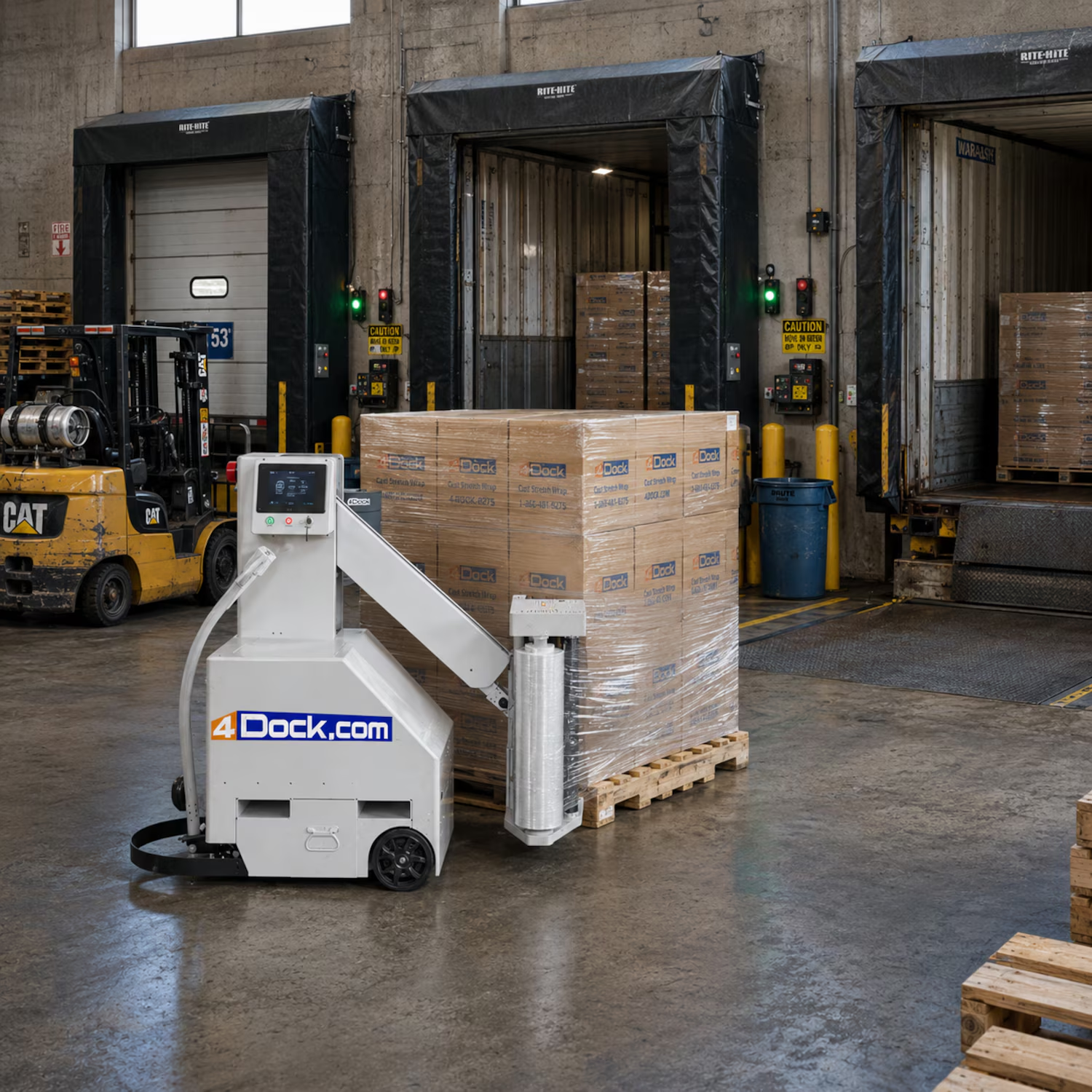

The 4Dock Semi-Automatic Stretch Wrapper is designed as a mobile semi-automatic solution, making it particularly relevant to operations where bringing the wrapper to the pallet may be preferable to dedicating every load to a fixed wrapping point.
Rather than deciding based on the product name alone, compare its specifications directly against the measurements you collected earlier.
The key question is not whether one stretch wrapper is universally “best.” It is whether its wrapping capacity, load compatibility, mobility, film system, operating requirements, and cost match your workflow.
That is the same evaluation process you should apply to every machine on your shortlist.
Frequently Asked Questions
Which semi-automatic stretch wrapper is best?
There is no single best machine for every operation. Start with pallet volume, maximum load dimensions, load stability, forklift or pallet-jack workflow, available space, film requirements, service support, and budget. The best choice is the machine that meets those requirements without unnecessary capacity or complexity.
How much does a stretch wrapping machine cost?
Pricing varies substantially according to machine type, automation level, capacity, film delivery system, mobility, controls, and optional features. Instead of comparing purchase price alone, calculate total ownership cost using equipment, labor, film, maintenance, and expected downtime.
What are common problems with wrapping machines?
Operational problems can involve film breaks, incorrect tension, inconsistent wrap settings, sensors, rollers, operator setup, or worn components. Maintenance requirements vary by machine, which is why parts availability and technical support should be evaluated before purchase.
How long does a stretch wrapping machine last?
There is no useful universal lifespan. Service life depends on machine design, utilization, environment, maintenance, operating practices, and parts availability. For procurement purposes, maintenance requirements and long-term support are more actionable than a generic lifespan estimate.
Is it better to rent or buy a wrapping machine?
Renting may make sense for temporary, seasonal, or uncertain demand. Buying becomes more compelling when pallet wrapping is a stable recurring process and expected labor, film, or throughput benefits can justify the investment over the planned ownership period.
Buy for Your Workflow, Not the Spec Sheet
Choosing a semi-automatic stretch wrapper becomes much easier when you stop asking which machine has the longest feature list.
Start with your operation:
Volume → Load → Workflow → Film → Cost → Maintenance → Growth
Measure real pallets. Record peak throughput. Calculate current wrapping labor and film consumption. Understand how pallets physically move through your shipping area. Then use those numbers to compare machines.
That approach helps you avoid both sides of a costly purchasing mistake: buying too little machine for the job or paying for automation your operation does not need.
When you are ready to compare a real option against those requirements, review the 4Dock Semi-Automatic Stretch Wrapper specifications and evaluate the machine against your actual pallet dimensions, volume, workflow, and growth plans.