


Fixed-Position Heavy-Duty vs Hand Crank vs Electric Adjustable Workbenches: How to Choose
Choosing an adjustable workbench often feels more complicated than it should. All three types—fixed-position heavy-duty, hand crank, and electric—adjust in height, yet they vary widely in cost, capacity, and day-to-day usability.
If you’re already convinced that an adjustable workbench makes sense for your operation, the real question becomes: which adjustment method actually fits how the bench will be used? This guide breaks down the three main types of adjustable workbenches, clarifies their differences, and helps you make a final, confident decision.
Why Adjustable Workbenches Are Often Misunderstood
One reason buyers struggle with this choice is terminology. “Manual,” “mechanical,” and “adjustable” are often used interchangeably online—even though they describe very different designs.
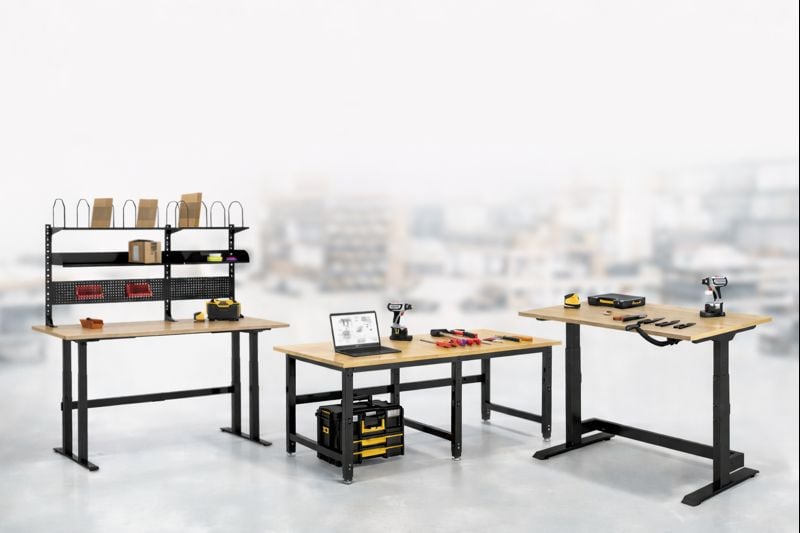
In practice, adjustable workbenches fall into three distinct categories: fixed-position heavy-duty adjustable height workbenches, hand crank adjustable workbenches, and electric adjustable workbenches. Each serves a specific purpose, and problems arise when a bench is chosen for features it offers on paper, rather than how it will actually be used day to day.
Note: fixed-position heavy-duty adjustable height workbenches are sometimes informally referred to as “pin-set” benches online. In industrial environments, the defining characteristic is not the pin itself—it’s the load-bearing structure, intended use, and long-term stability after setup.
Fixed-Position Heavy-Duty Adjustable Height Workbenches: Maximum Stability, Minimal Adjustment
Fixed-position heavy-duty adjustable height workbenches use preset height positions secured by reinforced pins or bolts through pre-set holes in the legs. Height changes are deliberate and infrequent, typically requiring the workstation to be unloaded.
These benches are designed for environments where load capacity and rigidity matter far more than frequent adjustment. Once the height is set, the bench effectively functions as a fixed-height workstation.
- Best for: Heavy loads, high stability requirements, fixed-process stations
- Typical use pattern: Set height during setup, then leave it
- Tradeoff: Not practical for frequent changes or quick sit-stand switching
If your workflow prioritizes maximum load capacity and long-term stability over frequent adjustment, fixed-position heavy-duty adjustable height packing tables are often the most practical solution.
Hand Crank Adjustable Workbenches: Mechanical Flexibility Without Power
Hand crank adjustable workbenches bridge the gap between fixed-position and powered systems. Height is adjusted continuously using a mechanical crank, allowing a single operator to raise or lower the work surface without electricity.
This design appeals to buyers who want real adjustability, but don’t need instant changes or powered components.
- Best for: Occasional height changes, simple maintenance, no power requirement
- Typical use pattern: Adjust between tasks or shifts
- Tradeoff: Slower than electric and requires manual effort
If you want continuous adjustment without electrical components, a hand crank adjustable workbench is a strong fit for many workshop and production workflows.
Electric Adjustable Workbenches: Fast, Frequent Height Changes
Electric adjustable workbenches use motorized lifting systems to raise and lower the work surface at the push of a button. They offer the greatest convenience and often the widest height adjustment ranges.
These benches are designed for high-frequency adjustment and shared workstations, rather than maximum load capacity.
- Best for: Multi-user stations, frequent height changes, sit-stand workflows
- Typical use pattern: Adjust multiple times per day or per shift
- Tradeoff: Usually lower capacity than heavy-duty fixed-position benches; stability varies by design
If your workstations need fast height changes across operators or tasks, electric adjustable height workbenches are typically the best match.
Side-by-Side Comparison: Which One Fits Your Workflow?
| Factor | Fixed-Position Heavy-Duty | Hand Crank | Electric |
| Height adjustment range | Limited (e.g., 30"–36") | Moderate (e.g., 26"–40") | Wide (e.g., 24"–49") |
| Load capacity | Very high (up to 3,000 lbs) | Medium (typically ~500 lbs) | Medium (commonly 300–700 lbs) |
| Adjustment frequency | Rare | Occasional | Frequent |
| Adjustment speed | Slow | Moderate | Fast |
| Power required | No | No | Yes |
| Stability under load | Excellent | Very good | Good (design-dependent) |
| Best for | Fixed processes, heavy loads | Flexible tasks, low maintenance | Shared stations, sit-stand use |
This comparison highlights a key insight from real users: the best adjustable workbench is the one that matches how often you’ll actually adjust it.
Common Buying Mistakes (From Real Users)
- Overbuying adjustability for benches that rarely change height
- Ignoring load requirements, especially when selecting electric models for heavy-duty applications
- Prioritizing speed over stability when rigidity is the real requirement
In many cases, dissatisfaction comes not from the bench itself, but from choosing the wrong adjustment method for the workflow.
Final Decision Guide: Choose in Three Questions
- How often will the height actually change? Rare → Fixed-position heavy-duty. Occasional → Hand crank. Frequent → Electric.
- How many people use the bench? One → Fixed-position heavy-duty or hand crank. Multiple → Electric.
- How heavy is the typical load? Very heavy → Fixed-position heavy-duty. Moderate → Hand crank or electric.
Answering these honestly usually makes the best choice clear.
Quick FAQ
What is the difference between fixed-position heavy-duty, hand crank, and electric adjustable workbenches?
Fixed-position heavy-duty benches adjust to preset height positions and prioritize stability and load capacity. Hand crank benches provide continuous adjustment without power. Electric benches enable fast, frequent height changes for shared or sit-stand workstations.
Which adjustable workbench is best for heavy loads?
For heavy loads and maximum rigidity, fixed-position heavy-duty adjustable height workbenches are typically the best option because they are engineered for high capacity and long-term stability after setup.
Are electric adjustable workbenches stable enough for daily use?
Well-designed electric benches are stable for daily use when operated within rated load limits, but stability can vary by design and may decrease at maximum height. Choosing a bench rated above your working load is a common best practice.
How do I choose the right adjustable height range?
Choose a height range that supports both your primary task posture and your operators. Wider ranges are helpful for shared stations and sit-stand use, while limited ranges can be sufficient when the bench height is set once and rarely changed.