


Gun Workbench for Firearm Manufacturing: Industrial Requirements & Buyer’s Guide
In firearm manufacturing environments, a gun workbench is not simply a surface to work on—it is part of the production infrastructure. The stability, size, and construction of the workbench directly influence assembly accuracy, operator safety, and long-term process consistency.
While the term gun workbench is often used broadly online, its meaning changes significantly in a manufacturing context. This article is written specifically for firearm manufacturers, contract assemblers, and training weapon producers evaluating workbenches for production, assembly, and inspection—not for hobbyist or garage setups.
In production environments, the wrong workbench choice does more than slow operations. It can introduce variability into torque-sensitive processes, accelerate equipment wear, and increase ergonomic risk for operators over time.
Common Gun Workbench Use Scenarios in Firearm Manufacturing
In firearm manufacturing facilities, workbenches are integrated into defined production stages rather than used as general-purpose tables. Typical use scenarios include:
- Component assembly of upper receivers, lower receivers, barrels, and subassemblies
- Torque-critical operations, such as barrel installation and fastener tightening
- Fixture- and jig-based processes, where components are repeatedly clamped or positioned
- Inspection and quality control stations for dimensional checks and verification
- Manual workstations supporting semi-automated lines, often upstream or downstream of automation
Across these scenarios, the workbench must support static loads, dynamic forces, and repetitive operations across multiple shifts. Unlike hobbyist environments, height changes are rare, while repeatability and rigidity are essential.
In this context, the workbench functions as part of the manufacturing process itself—not as a flexible or temporary setup.
Industrial Requirements for Gun Workbenches in Firearm Manufacturing
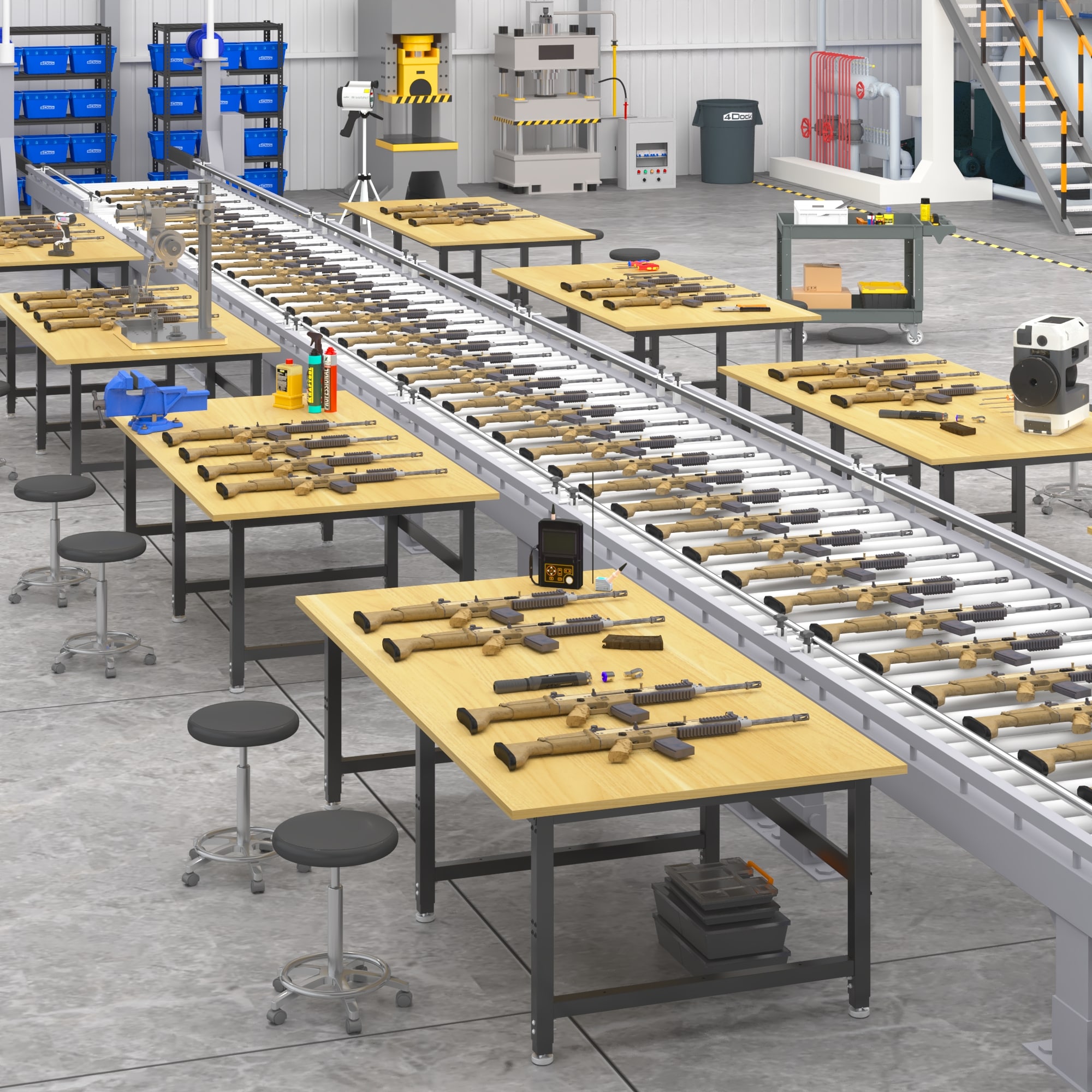
When these production scenarios are examined closely, several non-negotiable requirements emerge. These requirements are driven by manufacturing realities rather than convenience or aesthetics.
Stability Under Force and Torque
Many firearm assembly steps involve the application of significant force, particularly during torque operations. Even minor deflection or movement at the work surface can affect alignment, fastener consistency, or fixture accuracy.
Organizations such as OSHA and NIOSH consistently emphasize that workstation stability during force application helps reduce injury risk and process variability in manufacturing environments. In practice, this means firearm manufacturing workbenches must prioritize rigid frames and minimal flex under load.
Load Capacity Expectations in Production Environments
A common misconception is that load capacity only needs to account for the firearm itself. In reality, fixtures, vises, tooling, and applied force often exceed the weight of the components being assembled.
In firearm manufacturing environments, workbenches are commonly selected to support approximately 1,000–3,000 lbs of static load, providing sufficient margin for tooling and long-term use. Light-duty or hobby-grade benches rated below this range frequently experience joint loosening or surface deflection over time when subjected to repeated torque operations.
Surface Size and Layout for Long-Gun Assembly
Bench dimensions play a critical role in safe and efficient firearm assembly. For rifle and long-gun applications, manufacturers typically evaluate bench depths of 36–48 inches to provide stable front-to-back support for extended components and fixtures.
Insufficient depth often results in overhang, reduced clamping stability, and increased handling risk—especially during inspection or torque-intensive tasks.
Materials and Construction for Long-Term Use
From a materials standpoint, firearm manufacturing workbenches commonly feature heavy-gauge steel frames paired with solid hardwood or reinforced laminate work surfaces. These materials provide a combination of impact resistance, vibration damping, and durability under repeated tooling loads.
Over time, lighter construction materials tend to transmit vibration and wear more quickly, affecting both operator comfort and process consistency.
Consistency Across Multiple Workstations
In production environments, consistency is often more valuable than flexibility. Standardized bench height, surface size, and configuration across multiple workstations support repeatable ergonomics, predictable cycle times, and easier training.
For many firearm manufacturers, this makes fixed-height or fixed-position configurations more suitable than frequently adjusted setups.
Manufacturing Risks Often Traced Back to Improper Workbench Selection
Although workbenches are rarely highlighted in process diagrams, they frequently surface during quality audits and safety reviews.
Common production issues linked to improper workbench selection include:
- Assembly variation caused by surface deflection during torque-sensitive operations
- Fixture misalignment resulting from insufficient frame rigidity
- Operator fatigue and strain caused by workbench heights that are not adjustable to fit different operators or tasks
- Long-term loosening or deformation of light-duty tables under continuous load
- Safety concerns related to unstable mounting of vises or tooling
Manufacturing and ergonomics research consistently links workstation design to both productivity and musculoskeletal injury risk. In regulated or precision-driven industries like firearms manufacturing, these issues can accumulate quietly until they affect output or safety metrics.
Why Industrial-Grade Workbenches Are Typically the Right Choice
Because firearm manufacturing workbenches function as production assets, industrial-grade designs are often the most appropriate solution.
Industrial workbenches are engineered with reinforced frames, high static load ratings, and construction methods intended for long service life under repetitive stress. Their design priorities align with manufacturing requirements: durability, consistency, and scalability.
For facilities deploying multiple identical workstations, industrial-grade benches also support standardization—making training, maintenance, and future expansion more predictable.
In this environment, a gun workbench should be evaluated with the same rigor applied to other production equipment.
Trusted Workbench Brands for Firearm Manufacturing (Quick Overview)
Once requirements are clearly defined, manufacturers often evaluate a short list of established industrial brands. The examples below are commonly considered in production environments where stability and capacity matter, though suitability depends on configuration and application—not brand name alone.
- Lista – Known for precision industrial workstations used in manufacturing and inspection environments
- 4Dock – Heavy-duty industrial workbenches designed for production-scale use, including:
- WB5 Heavy-Duty Industrial Classic Workbench (90" x 48")
- WB5 Heavy-Duty Industrial Classic Workbench (72" x 36")
- Adjustable Industrial Workbench / Packing Table (90" x 36")
- Global Industrial – Broad industrial equipment range with select heavy-duty workbench options
- BenchPro – Modular industrial bench systems used in manufacturing settings
- Uline (Industrial Series Only) – Selected heavy-duty models suited for light-to-moderate production use
Not every model from these brands is suitable for firearm manufacturing; specifications and intended use should always guide selection.
Selecting the Right Size and Configuration for Production Floors
Choosing the correct workbench configuration depends on both firearm components and production layout.
Surface dimensions should support the longest assemblies without crowding. Load capacity should account for tooling, fixtures, and applied force—not just component weight. While adjustable-height benches may be useful in mixed-use stations, fixed-height configurations often provide better consistency in dedicated production cells.
Selecting the right configuration early helps avoid costly rework as production scales.
Conclusion
In firearm manufacturing, a gun workbench is not a generic table—it is a foundational production asset. The right workbench supports assembly accuracy, operator safety, and consistent output over years of use. The wrong choice introduces risk, variability, and hidden costs.
By grounding workbench selection in real manufacturing scenarios and industry-informed requirements, firearm manufacturers can build production environments that support both quality and long-term growth.
SEO Setup
SEO Title: Gun Workbench for Firearm Manufacturing: Industrial Requirements & Buyer’s Guide
Meta Description: Looking for a gun workbench suitable for firearm manufacturing? Learn the industrial requirements for stability, load capacity, surface size, and safety—plus trusted brands used in production environments.
URL: /blog/gun-workbench-firearm-manufacturing
Core Keywords: gun workbench; firearm manufacturing workbench; industrial gun workbench; heavy-duty workbench for firearms; gun assembly workstation